Is HR Dying? What MBA Aspirants Should Know Before Choosing HR in 2026
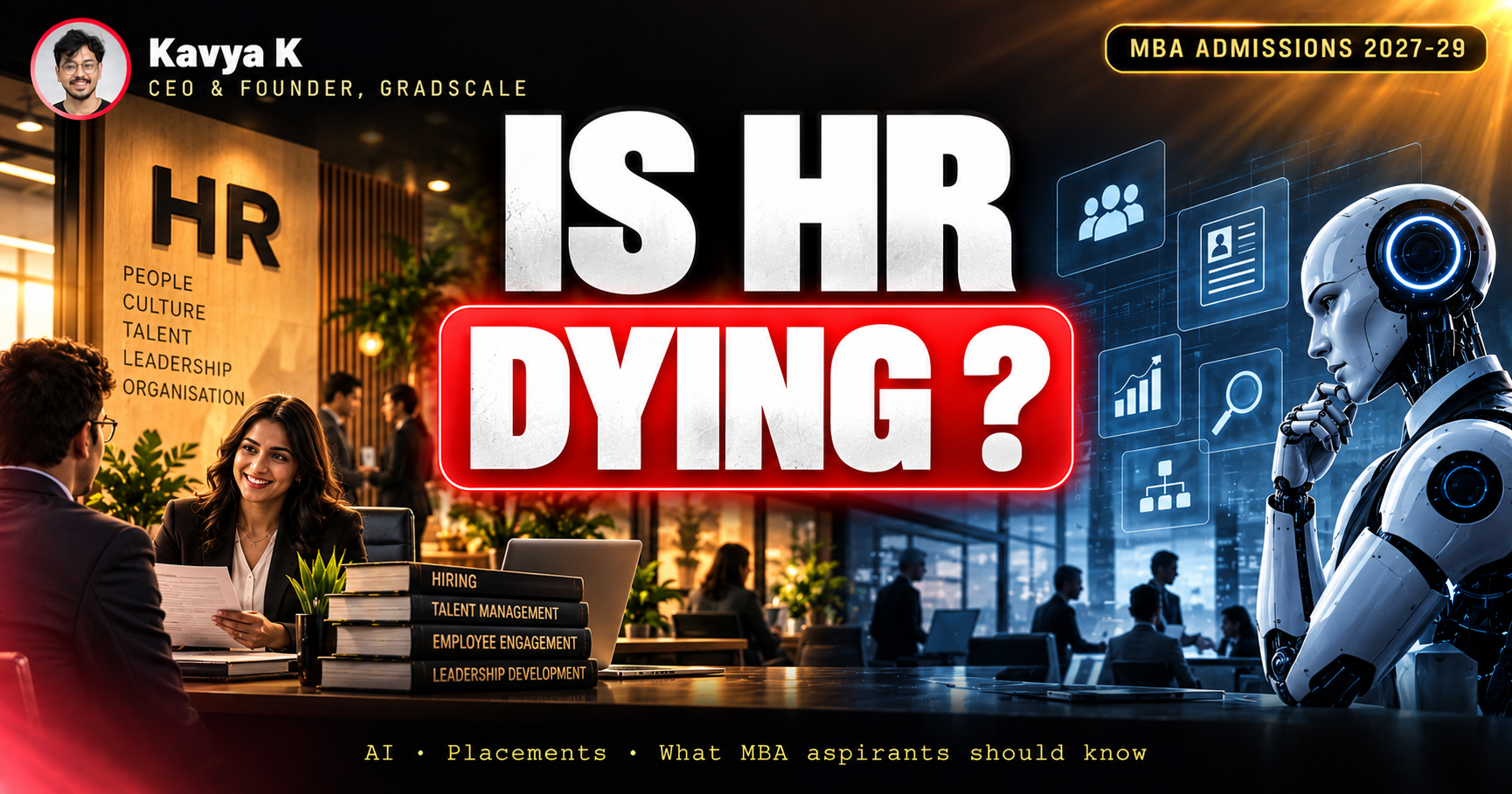
Every few months a headline announces the end of HR. In August 2026, the CEO of SHRM, the world's largest HR body, told roughly 20,000 practitioners at its annual conference in Orlando that the profession's livelihoods are at risk and that HR could face extinction if it refuses to rethink its role. If you are about to spend two years and several lakh rupees on an MBA in HR, that is a fair thing to worry about. This guide separates what AI is actually doing to HR work from what the headlines say, and then tells you what to do about it as an MBA aspirant.
Short Answer
No, HR is not dying. A lot of what HR does today is being automated, and the people-team of 2030 will look different from the one in 2020. The risk is not to the function; it is to a narrow, task-based version of the HR career (resume screening, scheduling, payroll queries, document processing). An MBA in HR that trains you for strategy, analytics, employee relations and AI governance is aimed at the part that is growing.
Why the "HR Is Dying" Story Keeps Coming Back
HR has always been easy to call dispensable because it is a support function. When companies cut costs, support functions get the first look. In 2026, AI adds a second reason, because HR work is full of tasks that software now does reasonably well: drafting job posts, sorting resumes, answering policy questions, summarising performance reviews and onboarding new hires.
HR is also an early adopter. The Hackett Group reported that 66% of HR teams used generative AI in 2025. So HR is the department where the effect of AI is visible first, and that makes it the department most often used as the example.
How We Looked at This
This is not a forecast. It is a reading of the best recent evidence we could find, with the limits of each source stated. A few cautions:
- Many figures below are from the United States, because that is where the best HR workforce data is published. Indian data on HR roles specifically is thin, so we use Indian hiring surveys for the wider job market and the placement reports in our earlier B-school guide for MBA outcomes.
- Some surveys are small or are run by vendors who sell HR technology. We say so where it matters.
- Nothing here is a guarantee about your placement. Treat every number as a snapshot.
What the Evidence Says
Two things stand out. First, the warning from SHRM's CEO and SHRM's own research point in slightly different directions: the CEO is warning about complacency, while the data show reshuffling more than disappearance. Second, the declining roles in the WEF report are clerical and administrative ones, which overlap with the routine end of HR work and not with the strategic end.
What Is Actually Changing in HR
Tasks are leaving HR, and some are leaving HR departments entirely
Chris Courneen, SVP of HR at MSI International, told Bloomberg that all the work historically handled by HR will not stay with HR. Managers, finance teams and software platforms are picking up pieces of hiring, scheduling, training, payroll and employee support. For a fresher, this means fewer entry-level processing roles and more expectation that you arrive able to do analysis.
Compliance work is growing, not shrinking
AI can draft a job post or rank candidates, but the employer still owns the outcome. The US Equal Employment Opportunity Commission has named the use of AI in advertising, recruiting and hiring decisions as an enforcement priority. Bias testing, documentation and meaningful human review are becoming part of the HR job description. Indian companies hiring globally, or serving US and EU clients, face the same pressure.
AI is becoming part of the job title
Indeed Hiring Lab counted 822 standardised US job titles with AI in the title in the first quarter of 2026, up from 264 in the first quarter of 2022, and 63% of those were outside traditional tech occupations. The pattern is that employers add AI to familiar roles instead of building a separate workforce. Expect the same for "AI-enabled talent partner" or "people analytics lead".
What This Means in India
Indian hiring data for 2026 does not look like a profession in decline, though it is not an easy market either.
The Naukri survey also found that skills, not demand, is the sharper constraint. Competition for each opening has risen, so the average candidate is facing a harder process. The candidates who do well will be the ones with skills that employers cannot get from a tool.
What MBA HR Placements Tell Us
The strongest evidence that HR is not dying is that the top programmes keep placing their students at healthy packages. From the placement reports covered in our B-school guide:
Read these with care. The cohorts are small, some figures come from different batches, and at MDI the HR average sits below the whole-batch average, so HR pays less than the headline number a college advertises. XLRI and SCMHRD do not publish a clean HR-only figure in the reports we read. Even so, none of these numbers describe a market that has collapsed.
How to Pick an HR Path That Holds Up
- Choose the strategic end of HR. Talent strategy, compensation and benefits, organisational design, people analytics, employee relations and labour relations are harder to automate than screening and scheduling.
- Learn the data side. You do not need to become a data scientist. You do need to be comfortable with dashboards, attrition models and basic statistics. The Taggd hiring guide notes that HR professionals who combine business sense with analytics earn a premium, though that figure comes from a recruitment firm and should be treated as indicative.
- Learn how AI tools are built and audited. Bias testing, vendor evaluation and data privacy will sit with someone. It can be you.
- Do a real internship in a business function. HR professionals who understand operations, sales or finance are the ones who get pulled into leadership conversations.
- Compare programmes on placements, not just the brand. Use the HR-specific numbers where a college publishes them.
Who Should Think Twice
- If your main attraction to HR is that it looks like a soft, low-maths MBA stream, the data side will be a shock.
- If you want a role that is purely about processing, such as payroll operations or document handling, that is the work most exposed to automation.
- If you expect an HR MBA to give you the same packages as consulting or finance, the placement tables above show otherwise.
Frequently Asked Questions
Is HR a dying career? The evidence does not support that. SHRM's own research finds AI is much more likely to change jobs and create new roles than to eliminate them, and US government projections show HR employment growing. What is shrinking is routine HR work.
Why did SHRM's CEO say HR could go extinct? He was warning that HR cannot keep defending its old list of tasks while software gets better at them. It was a call to change the profession, and not a forecast that the function would vanish.
Will AI replace recruiters? It will replace parts of recruiting, such as screening and scheduling. Interviewing, closing candidates, advising hiring managers and handling bias and compliance risk still need people, and regulators expect meaningful human review.
Is an MBA in HR still worth it in 2026? For the programmes in our guide, placement data still show solid packages. Whether it is worth it for you depends on the programme's fee, your plans, and whether you build analytics and business skills alongside the HR curriculum.
Should I pick HR or a different MBA specialisation? If you are drawn to people, organisations and policy, and you are willing to work with data, HR is a reasonable choice. If you are mainly chasing the highest starting package, compare against finance, consulting and analytics tracks first.
Which HR skills are safest? Skills in analytical thinking, resilience and leadership rank among the most in-demand in the WEF report. In HR terms, that points to people analytics, workforce planning, employee relations and change management.
Is entry-level HR hiring drying up in India? Not according to Naukri's H2 2026 survey, where 62% of HR leaders planned to hire people with zero to three years of experience. But competition per opening has risen, so expect a harder selection process.
Final Word
HR is not dying, but the version of HR that is mostly paperwork is. The profession is splitting into routine work that software handles and judgement work that people handle, and an MBA is worth the money only if it prepares you for the second kind. Before you commit, read each college's latest placement report, look at the HR-specific numbers, and ask what share of the curriculum covers analytics, labour law and AI governance. Treat every figure here as a snapshot, because surveys change each cycle and some of the numbers above come from vendors and secondary reports.
Kavya Kumar
Founder of GRADSCALE, which he architected and built from scratch — the daily drill engine, PYQ access, analytics and leaderboards behind the platform's daily execution system.