How to Write an SOP for MBA in India (2026-27): Structure, Examples and Mistakes
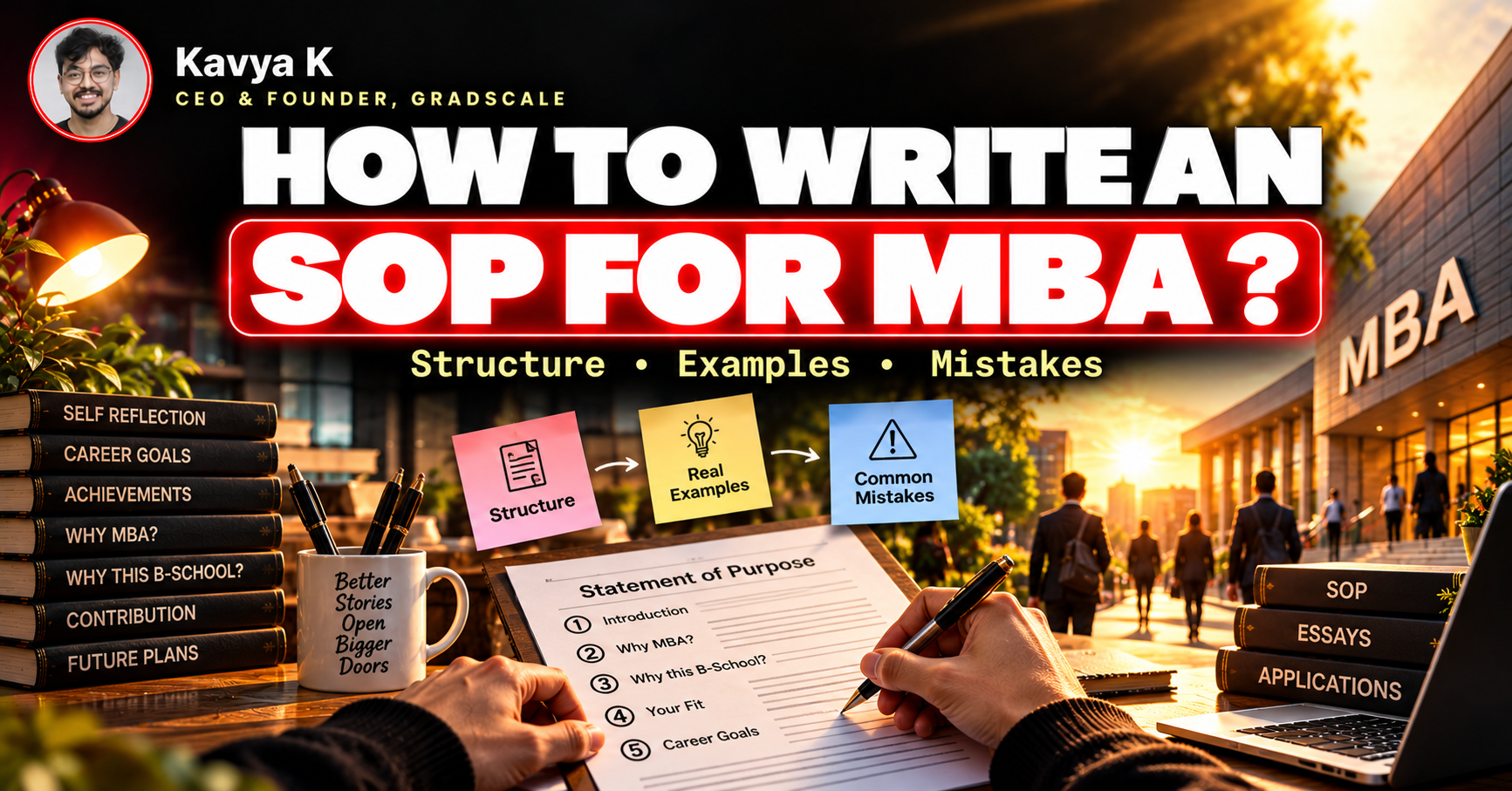
Not every B-school asks for a Statement of Purpose, but the ones that do read it closely and often use it to question you in the interview. Here is a four-part structure, weak-versus-strong lines and the mistakes that sink most drafts.
The Short Answer
A good MBA SOP answers four questions in order: who are you, why an MBA, why this school, and where are you headed. It is specific, honest and short enough to defend line by line in an interview. If you cannot talk about a sentence for two minutes, delete it.
Before anything else, one caution. SOP requirements differ by school and change from year to year. Some schools give you a text box with a word limit, some ask specific essay questions, some ask nothing and test the same ground in the interview. Open the current application form of each school you are applying to and follow its instructions. Treat everything below as a way to think, not as a rule from any school.
What an SOP Is (and Is Not)
The SOP is the only one of the three where you choose the story. That is also why it becomes the script for your interview: panels tend to pick up lines from what you wrote and ask you to expand on them. A claim you cannot back up becomes a problem the moment someone asks about it.
The Four-Part Structure
You do not need headings in the final text. Use these as the skeleton.
1. The Hook (2-3 sentences)
Start with one concrete moment or fact that explains how you ended up here, not a quotation or a grand statement about leadership.
- Weak: "I have always been passionate about business and want to become a leader who makes a difference."
- Strong: "In my second year as a plant trainee, I noticed that the night shift threw away nearly twice as many rejected parts as the day shift. Working out why, and persuading the supervisor to change the handover, was the first time I enjoyed a problem that was not on a syllabus."
The strong version gives the reader something to ask about. The weak version could be written by anyone, which is exactly the problem.
2. Why an MBA (one short paragraph)
Link a specific gap in your skills or your career to what a management degree gives you. "Networking" and "a salary jump" are real motives, but they are not an argument.
- Weak: "An MBA will help me grow professionally and expand my network."
- Strong: "I can improve a process, but I cannot yet build the business case for it. I have never worked with a P&L or priced a decision, and I want structured training in finance and operations before I take on a team."
Name a gap you actually have. Panels are more convinced by a candidate who knows what they lack than by one who claims to be ready for everything.
3. Why This School (one paragraph, only real specifics)
This is where generic drafts fall apart. A paragraph that would still make sense with another school's name pasted in is not doing its job.
- Weak: "Your institute is one of the best in India with excellent faculty, placements and infrastructure."
- Strong: "The operations electives and the live projects with manufacturing firms match the gap I described. I would also like to join the case competition team, because I have only ever solved problems alone."
Find your specifics from the school's own website, programme brochure, student clubs, electives and recent alumni profiles. Do not name a professor or a course unless you have confirmed it still exists this year.
4. Goals (short-term and long-term)
Keep it believable and connected to what came before.
- Short-term (first 2-3 years after the MBA): a role and a kind of company, for example operations consulting or a manufacturing strategy role.
- Long-term (8-10 years): a direction, not a job title you saw on LinkedIn.
- Weak: "In five years I see myself as a CEO of a Fortune 500 company."
- Strong: "In the first few years I want to work on supply chain redesign in a manufacturing or consumer goods company. Longer term, I want to run operations for a business at scale, and my plant experience is my starting point."
A one-line closing is enough. Do not end with a plea.
How Long Should It Be?
Follow the word limit on the form if there is one. If a school gives no limit, somewhere around 500 to 800 words is a sensible range in our judgement, since a reader going through hundreds of applications will not give you more attention for more length. Never go over a stated limit.
Common Mistakes
- Writing one SOP and changing the school name. Panels notice. Rewrite the "why this school" part from scratch every time.
- Listing achievements instead of telling a story. Your CV already does that. The SOP should explain the decisions behind it.
- Big claims without proof. "Excellent leader" means nothing. A team of four, a deadline and a result means something.
- Copying a sample. Samples online are read by thousands of other applicants, and panels have seen the same openings many times. Your own odd, specific details are your advantage.
- Hiding a weakness instead of explaining it. A gap year, a low score or a backlog will come up. A calm two-line explanation in the SOP is better than a defensive answer in the interview.
- Over-polished, empty language. If every sentence sounds impressive and none of them contains a fact, it reads as filler. Using an AI tool to write the whole thing is a fast route to this.
- Contradicting your form. If your form lists a role and your SOP describes it differently, the panel will notice.
- Typos and the wrong school name. Read it aloud once. It catches both.
Keep It Consistent With Your Form and Interview
Your application is read as one document, not as separate pieces. Before you submit, do this check:
- Dates and roles in the SOP match your form and CV exactly.
- Goals in the SOP match the specialisation you ranked first.
- Every claim has a story behind it you can tell in a minute.
- Preparation: pick five lines from your SOP and ask a friend to challenge each of them as an interviewer would. Where you stumble, either rewrite the line or prepare the answer.
If your SOP says you want to go into finance and your interview answers are all about marketing, the panel will assume one of them is not true.
A Simple Process That Works
- Write a rough, ugly first draft in one sitting without editing.
- Cut every sentence that could appear in anyone's SOP.
- Replace each vague claim with a fact, a number or an example.
- Rewrite the "why this school" paragraph separately for each school.
- Leave it for a day, then read it aloud.
- Ask someone who knows you whether it sounds like you.
Frequently Asked Questions
Do all MBA colleges in India ask for an SOP? No. Some do, some ask specific essay questions and some do not ask for one at all. The rules also change by year, so check the current form of each school.
How long should an MBA SOP be? Follow the limit given on the form. If there is none, around 500 to 800 words is a reasonable target.
Can I reuse the same SOP for several colleges? You can reuse the story, but rewrite the "why this school" part and the goals each time. A copy-paste draft is easy to spot.
Should I use a sample SOP as a template? Use samples to understand the structure, not the sentences. Copied openings are common, and your own details are the only thing that cannot be copied.
Can I use AI to write my SOP? Use it, if you wish, to tighten grammar or test whether a paragraph is clear. Do not let it write your story. It does not know your facts, and you will be questioned on them.
Will the SOP be discussed in the interview? Often it can be, since it is the document the panel has about you. Write only what you are ready to discuss.
Final Word
A good SOP is not a clever essay. It is a short, truthful account of why you want this degree, why this school and what you will do afterwards, written so that you can defend every line. Requirements, word limits and prompts differ by school and change every cycle, so always check the official application form and admissions page of each school before you write.
Kavya Kumar
Founder of GRADSCALE, which he architected and built from scratch — the daily drill engine, PYQ access, analytics and leaderboards behind the platform's daily execution system.