SNAP 2026: How to Choose the Right Programmes in the Form
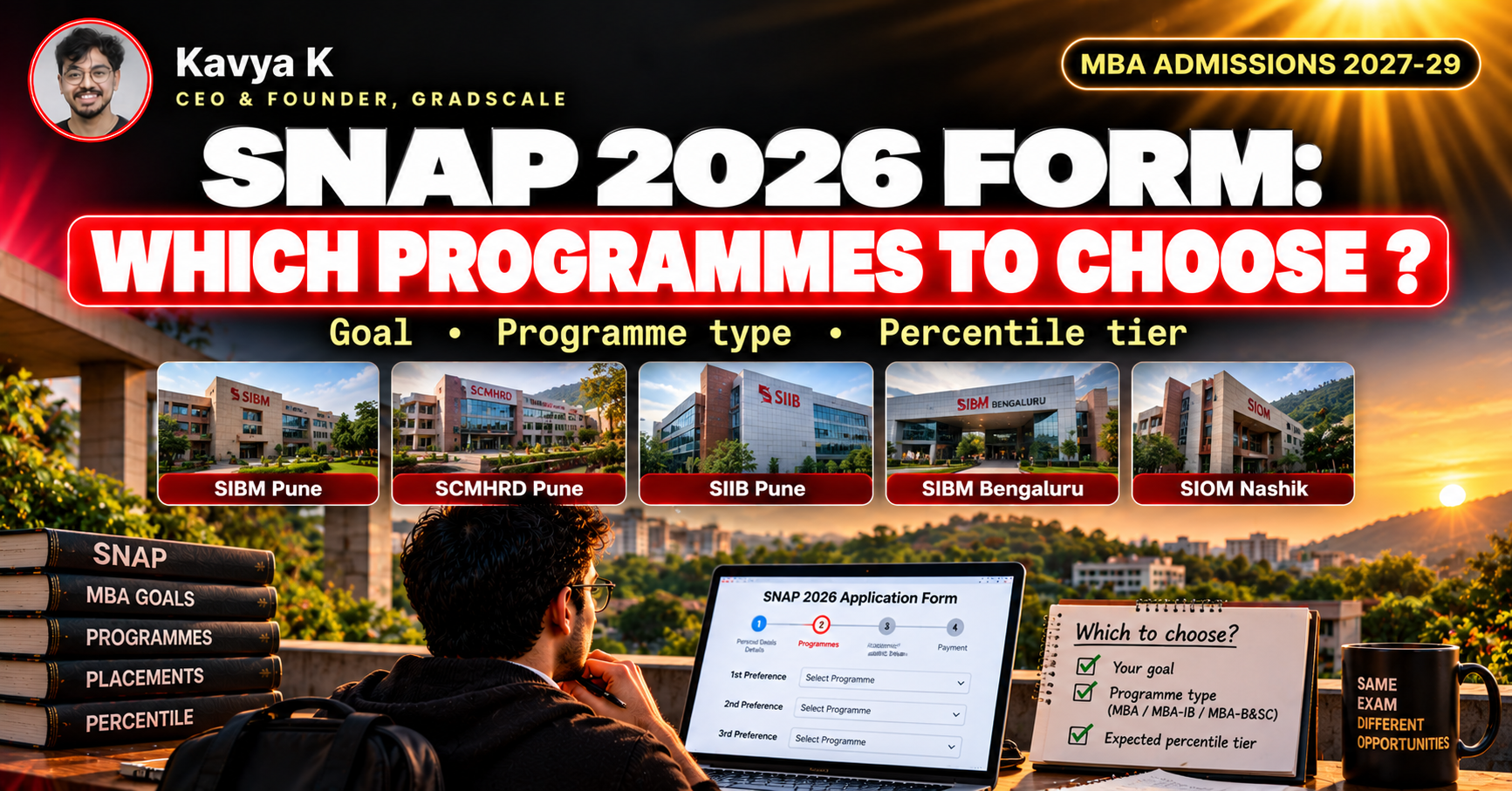
The SNAP form lists dozens of Symbiosis MBA programmes, and each one you pick costs extra. This guide shows how to choose by career goal, background and percentile, so your list has programmes you would actually join.
The Short Answer
Choose in this order: career goal first, then programme type, then institute, then percentile tier. Most students do it backwards. They start from the institute name, pick whatever carries the brand, and end up with a list that does not match what they want to do after the MBA. A good list is short, covers three percentile tiers and has a reason behind every programme.
What You Are Choosing From
For the 2027 admission cycle, the SNAP site says there are 32 MBA programmes across 17 Symbiosis institutes in Pune, Bengaluru, Hyderabad, Nagpur, Nashik and Noida. Three rules shape your choice:
- Each programme has its own fee. ₹1,000 plus taxes per programme, on top of ₹2,550 per SNAP test. Both are non-refundable.
- Each programme has its own process. Shortlisting is based on your overall SNAP percentile, but every institute sets its own cut-off. If you are shortlisted for several programmes, you attend a separate Group Exercise and Personal Interaction (GE-PI) for each.
- The interview matters. The published weightage is SNAP score 50, Group Exercise 10 and Personal Interaction 40. So you will be asked, in person, why you picked that programme.
We could not confirm whether the form caps the number of programmes or asks you to rank them. The guides we read do not say, so check the official bulletin.
Step 1: Decide What You Want to Do After the MBA
Answer this honestly before you open the form. Then use the table to find the programme type.
Step 2: Understand the Programme Types
Programme names below are as listed by a third-party portal, so confirm the exact names and which institute offers what on the SNAP site.
Flagship general MBA
Offered at SIBM Pune, SCMHRD, SIBM Bengaluru, SIMS and the other SIBM campuses. You get a broad management core and choose your specialisation later. Pick this if you want flexibility or are aiming at marketing, finance, consulting or general management. Watch out: these are the most competitive seats, so they usually need the highest percentiles.
Business Analytics, Data Science and AI
Offered under names such as Business Analytics, Data Science & Data Analytics and AI in Business. You study statistics, data tools and applying data to business decisions. Pick this if you like numbers and tools and want analyst or data-driven roles. Watch out: one portal reports that at least one Business Analytics programme asks for two years of work experience, so check eligibility before paying.
International Business
Covers trade, global markets and cross-border operations. Pick this if you are interested in exports, global supply chains or working with international firms. Watch out: be ready to explain what part of international business interests you. "I like travelling" will not carry a PI.
Operations and Supply Chain
Covers planning, logistics, procurement and process improvement. Pick this if you like solving process problems, especially if you come from engineering or have a plant or logistics background. Watch out: these roles are less visible than marketing or finance, so know what you will be doing day to day.
IT, Digital and Technology Management
Covers IT business management, digital transformation and technology management. Pick this if you want to work between business and technology. Watch out: if you want a pure management role, a tech-flavoured programme may narrow your options.
Banking and Finance
Covers banking, financial services and finance fundamentals. Pick this if you are clear that finance is your path. Watch out: finance roles in top firms are competitive, so a general MBA with a finance specialisation may serve you better if you want wider options.
Communication Management
Covers media, PR, brand communication and corporate communication. Pick this if you have a genuine interest in media or communication. Watch out: it is a narrow track, so be sure it is your first choice, not a fallback.
Sector programmes (healthcare, agri, food, sports, sustainability, infrastructure)
These train you for one industry. Pick these if you already know the sector, or have a degree or experience that fits it. Watch out: some have specific eligibility conditions, such as a particular academic background, so read the eligibility page first.
Innovation and Entrepreneurship
A specialisation for people who want to build a venture or work in startups. Pick this if you have a real idea or startup experience. Watch out: your interview will test whether the interest is real.
Step 3: Check the Fit With Your Profile
Step 4: Sort by Percentile Tier
Once you know the programme types, place institutes in tiers. The bands below are rough figures from one portal and change every year, so use them only to rank institutes against each other.
SIBM Nagpur, SIBM Noida and SSCANS had no band listed.
Build the list like this: - Ambitious (1-2): just above your expected percentile. - Realistic (2-3): around your expected percentile. - Safe (1-2): comfortably below it.
Use your mock average to estimate your percentile, not your best mock. Do not add a programme that you would not accept, because each one costs a fee and a GE-PI.
Common Mistakes
- Choosing by brand alone. The wrong programme at a famous institute can be worse than the right one at a smaller one.
- Ignoring eligibility. Work experience and background rules are easy to miss, and the fee is non-refundable.
- Selecting everything "to be safe". You pay for each programme, and each shortlist means another GE-PI.
- Picking a specialisation you cannot explain. The PI carries 40 of 100 marks.
- Waiting for the last day. Registration closes on 25 November 2026.
Frequently Asked Questions
Which programme should I choose if I am confused? Start from your career goal. If you honestly do not know, a flagship general MBA keeps the most options open.
How much does each programme cost? ₹1,000 plus taxes per programme, on top of ₹2,550 per SNAP test. Both are non-refundable.
How many programmes can I choose? We could not find a stated limit. Check the official bulletin and registration portal.
Do I need separate GE-PI rounds for each programme? Yes. If you are shortlisted for more than one, you attend GE-PI for each.
Can an engineer choose an analytics or operations programme? Yes, they are common fits, but check each programme's eligibility.
Does it matter which programme I rank first? We could not confirm that the form ranks programmes. Check the form itself.
Final Word
Pick the programme that matches the career you can explain in an interview, then build a small list across three percentile tiers. Programme names, fees, eligibility and cut-offs can change, so confirm everything on the official SNAP website and bulletin before you register.
Kavya Kumar
Founder of GRADSCALE, which he architected and built from scratch — the daily drill engine, PYQ access, analytics and leaderboards behind the platform's daily execution system.
